Case study
TrackBooks
Accounting, billing, taxation and financial insights for businesses in India, and the chartered accountants who serve them.
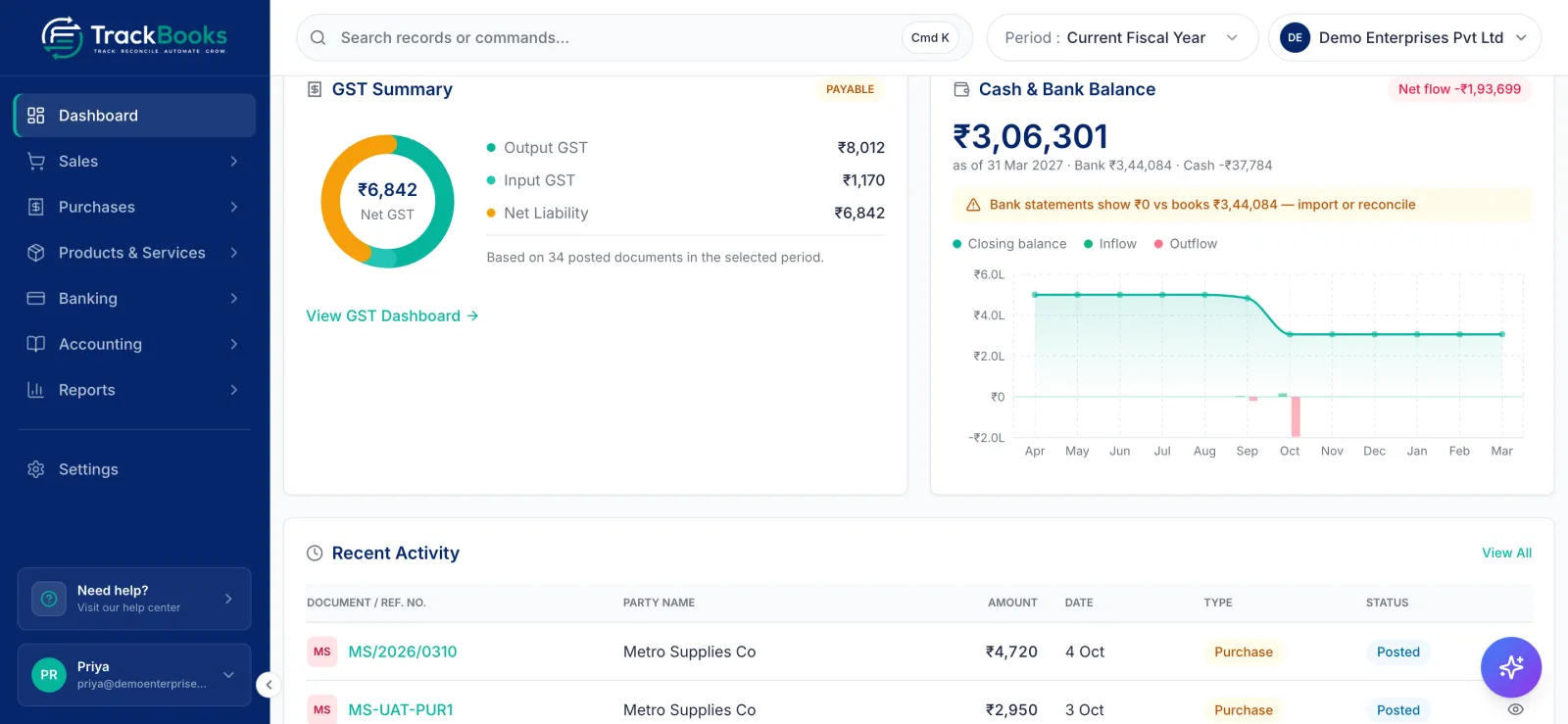
What is TrackBooks
TrackBooks is an AI-first accounting, billing, taxation and financial insights platform for businesses in India and the chartered accountants who serve them. It began in 2025 when two chartered accountant friends described the hours spent typing clients' bills into Tally by hand, and grew from AI invoice extraction into a complete accounting system. It is in use by practising chartered accountants on client books.
A business keeps its documents, bank statements and GST data in one place. AI reads the documents, the books are kept by double entry, the GST returns are prepared from the ledger, and ARIA, the platform's AI agent, does the accounting and answers questions in conversation. Validation and human review are built into the workflow.
Key features
Document capture
Bills and receipts as PDFs, photos or WhatsApp messages, read by AI and shown beside the extracted fields.
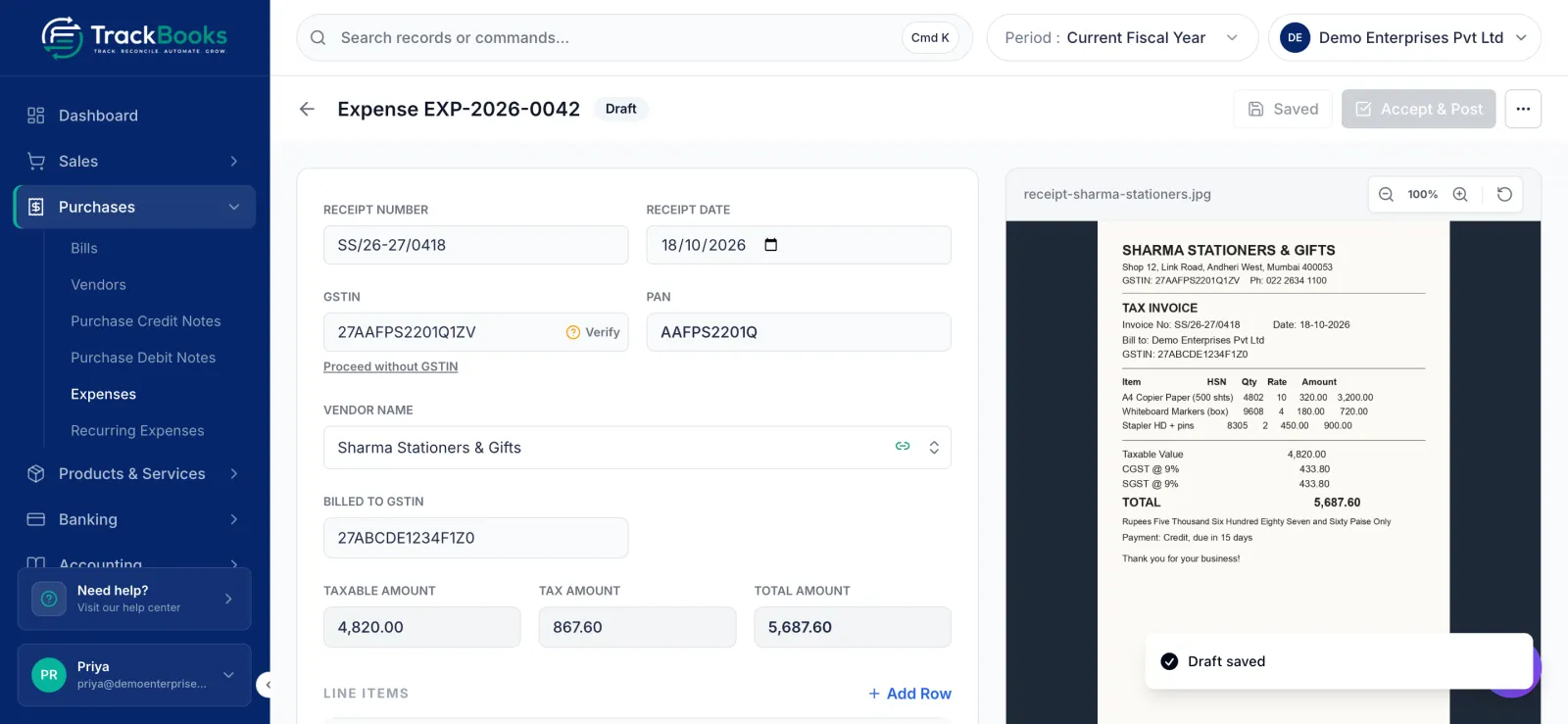
A scanned receipt beside the extracted fields. Sales and purchases
Invoices, debit and credit notes, expenses and recurring entries, across multiple companies and GST registrations. Every entry is shown balanced before it is posted.
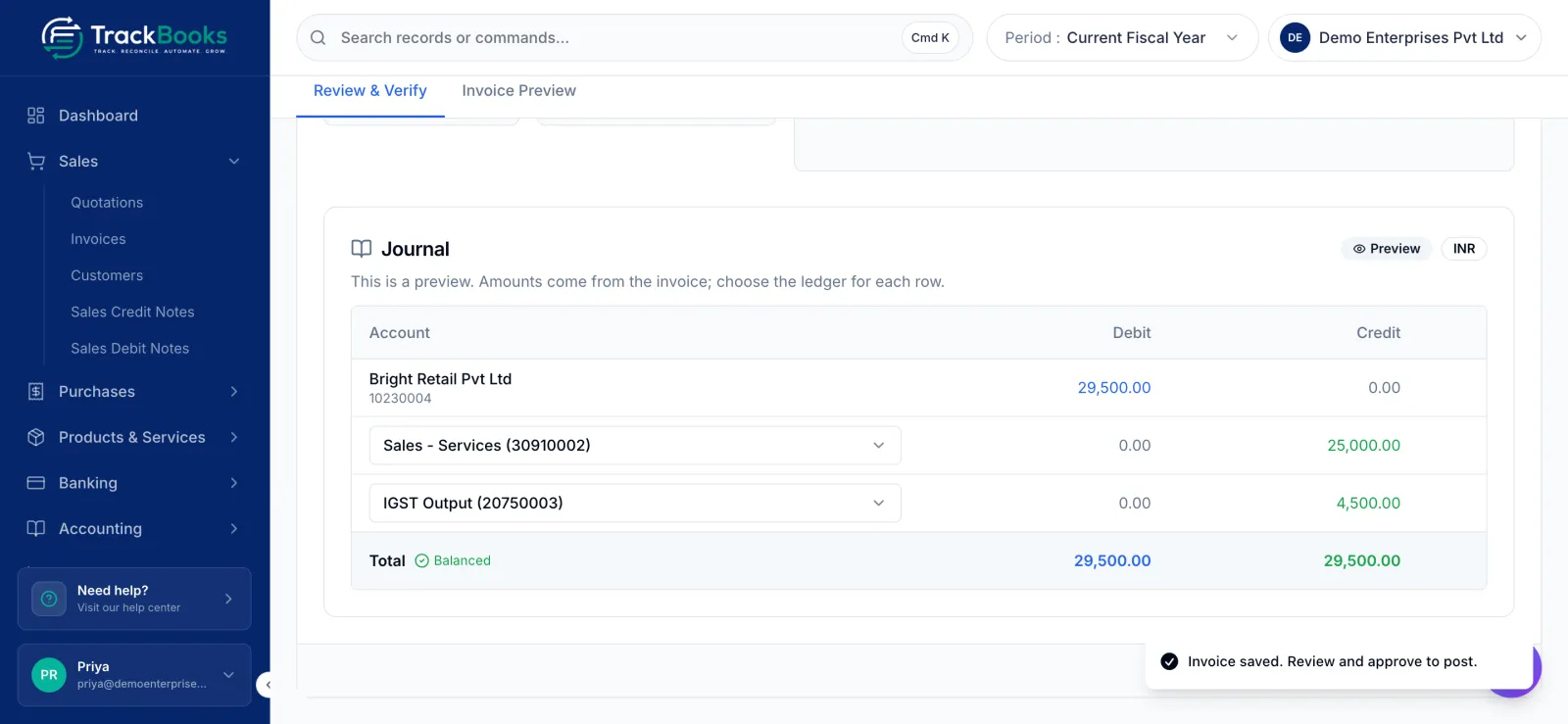
The journal entry shown for review before an invoice is posted. GST
GSTR-1 in the portal format, GSTR-2B retrieved and matched with purchase bills, and GSTR-3B. Exports, e-commerce, reverse charge, input service distribution and inter-branch transfers are handled.
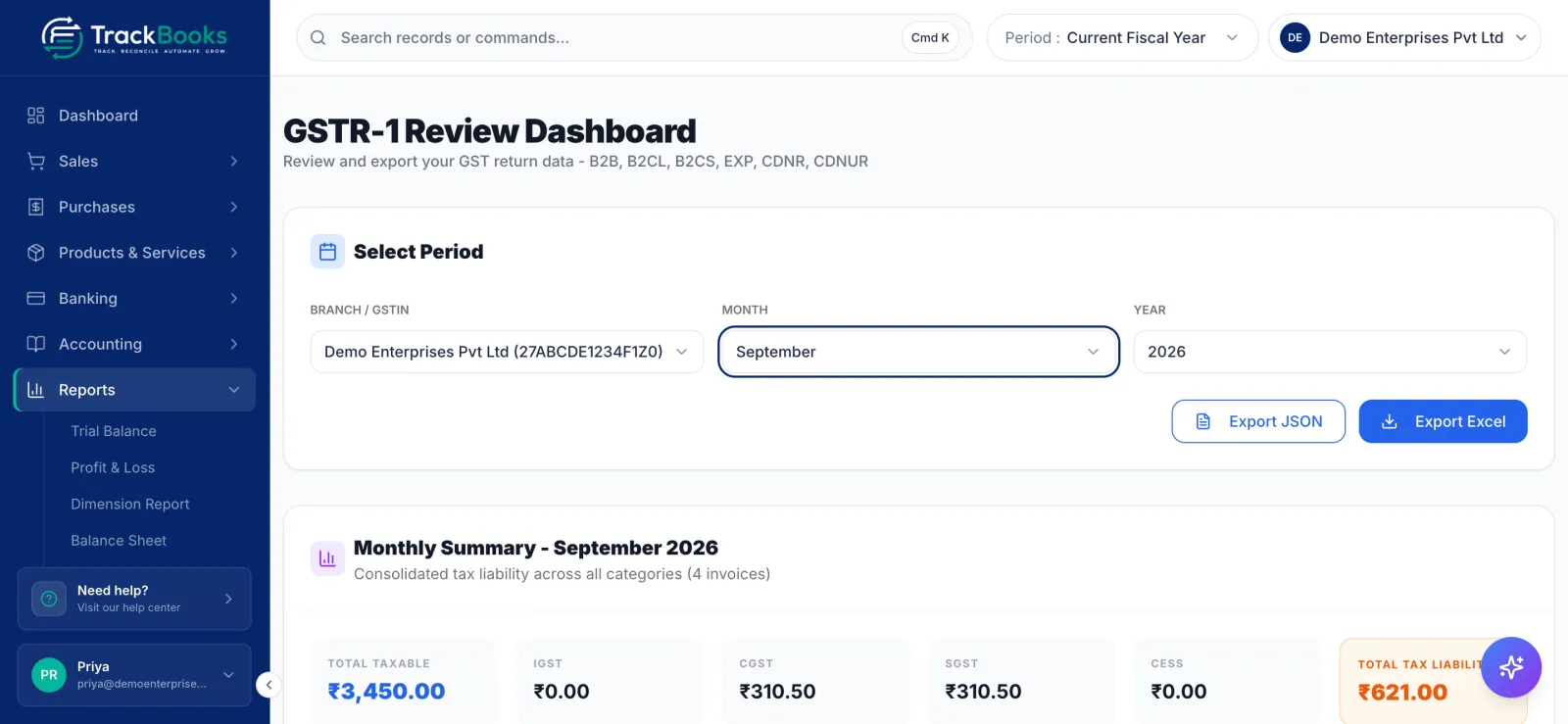
GSTR-1 with JSON and Excel export. Bank reconciliation
Statements from 27 Indian banks parsed at no AI cost, automatic matching, splits and partial payments, and the reconciliation statement.
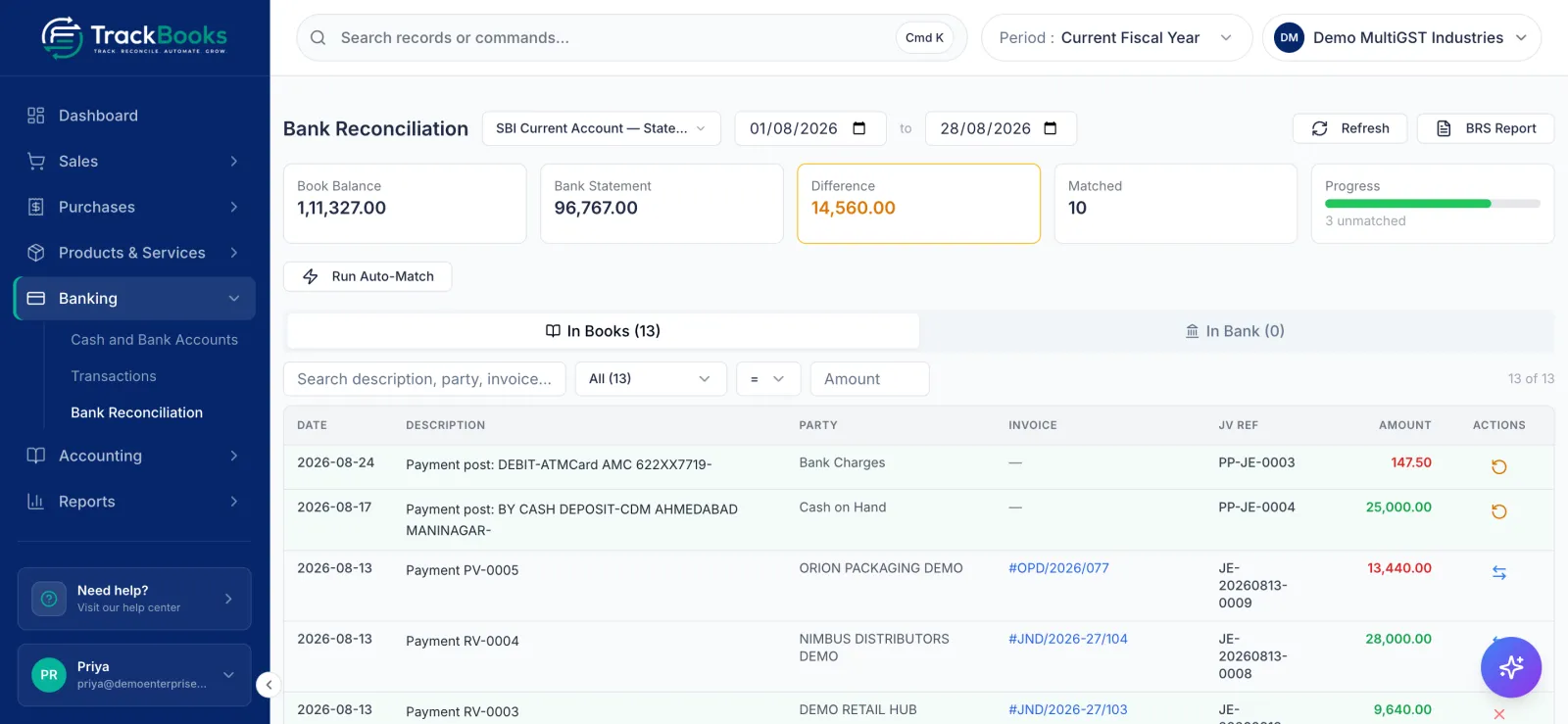
The reconciliation workspace. Inventory
Valued by FIFO or weighted average cost and tied to the accounts.
Fixed assets
A register with monthly depreciation under Schedule II, reconciled to the ledger.
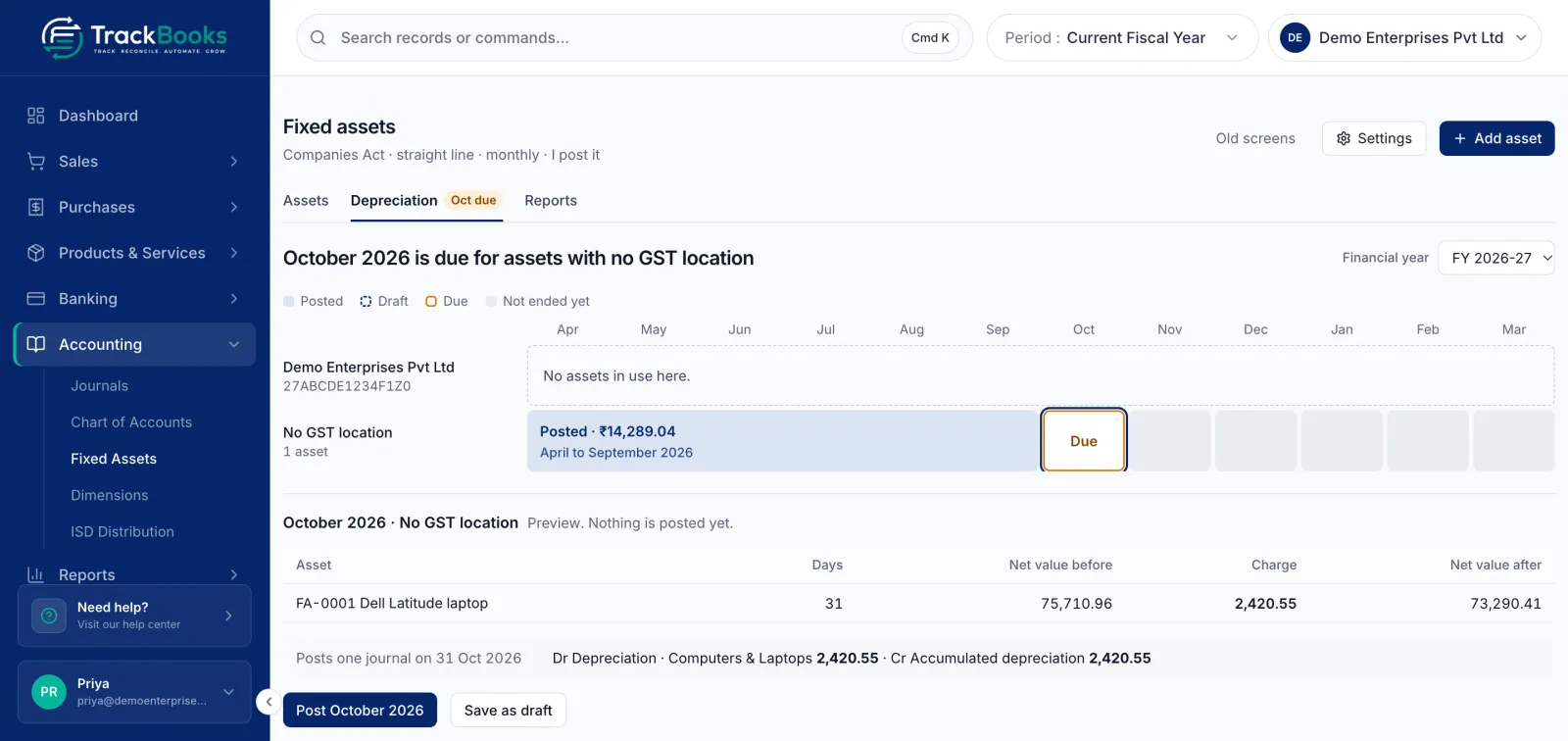
Monthly depreciation with the journal previewed. Reporting
Trial balance, profit and loss, balance sheet, cash flow, ratios, ageing, receivables and payables, in Excel and PDF, with statements in Schedule III form.
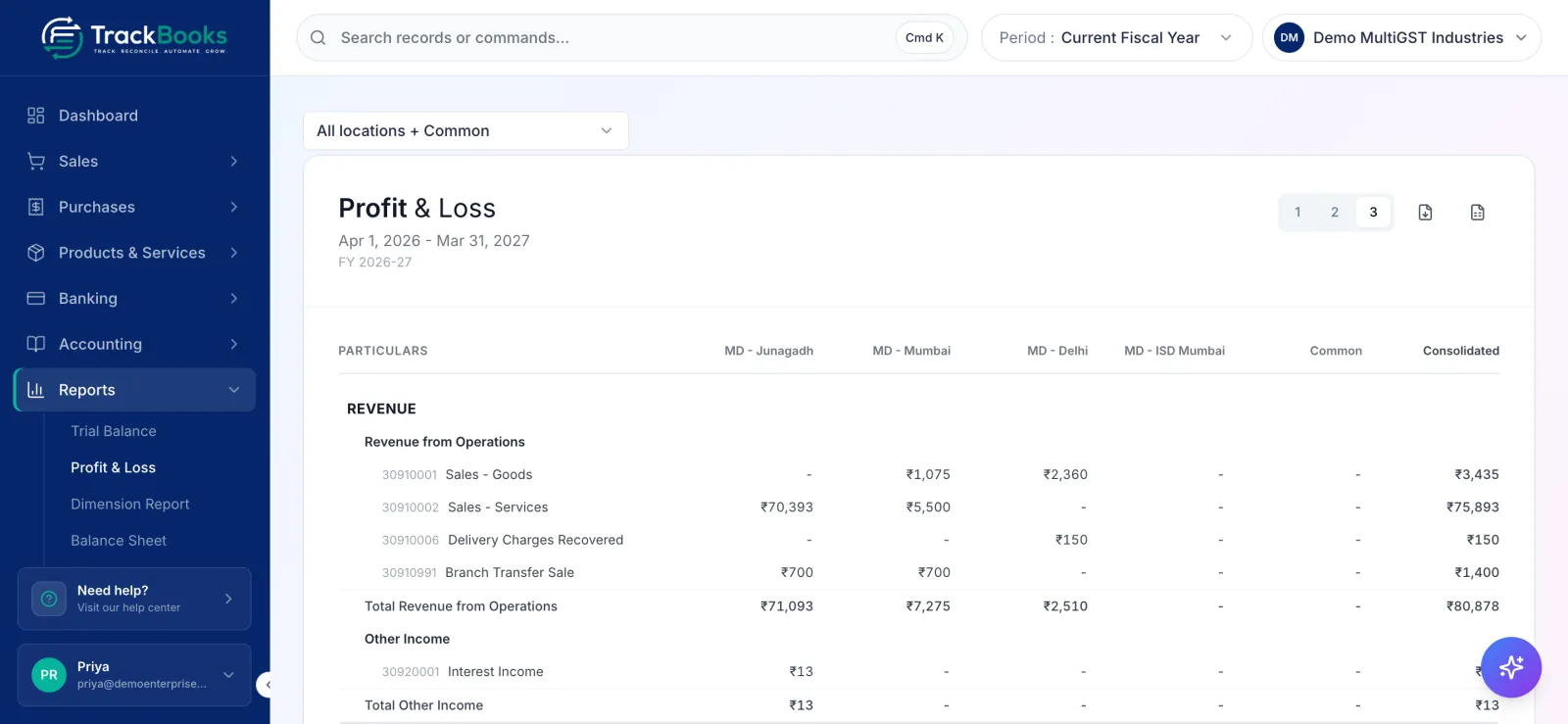
Profit and loss by GST registration. ARIA
ARIA is the platform's Accounting, Reporting and Insights AI agent, and carries out accounting tasks from natural-language instructions and uploaded documents. Users can describe a purchase, record a payment or upload a bill, and ARIA creates the accounting entries with validation and human review built into the workflow. It also answers questions about the books in English, Hindi or Gujarati with tables, charts and reports. Business owners with basic accounting knowledge can manage their books through conversation.
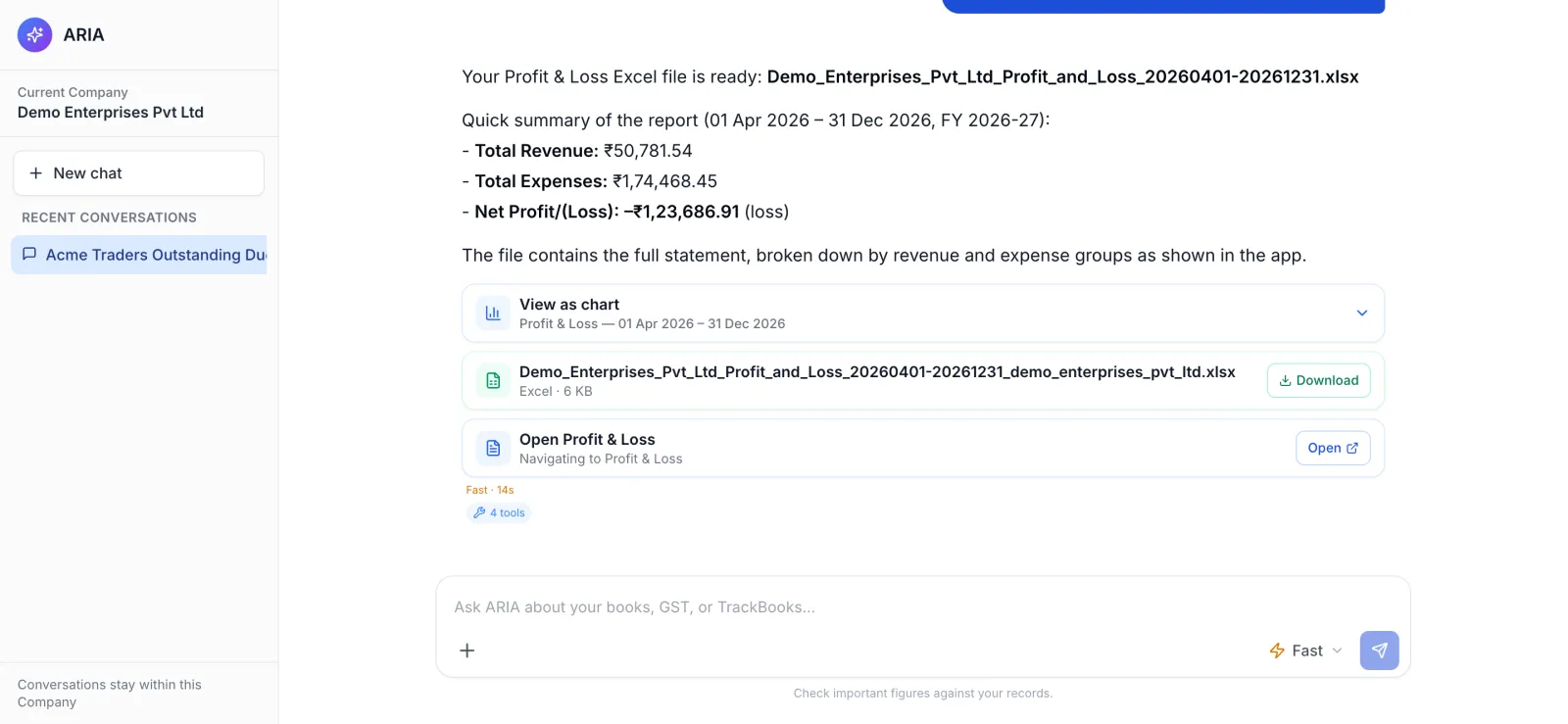
An answer with a chart, an Excel file and a link to the report. Migration from Tally
Books are imported through a desktop connector or XML files, and AI suggests how existing ledgers map to the new chart of accounts.
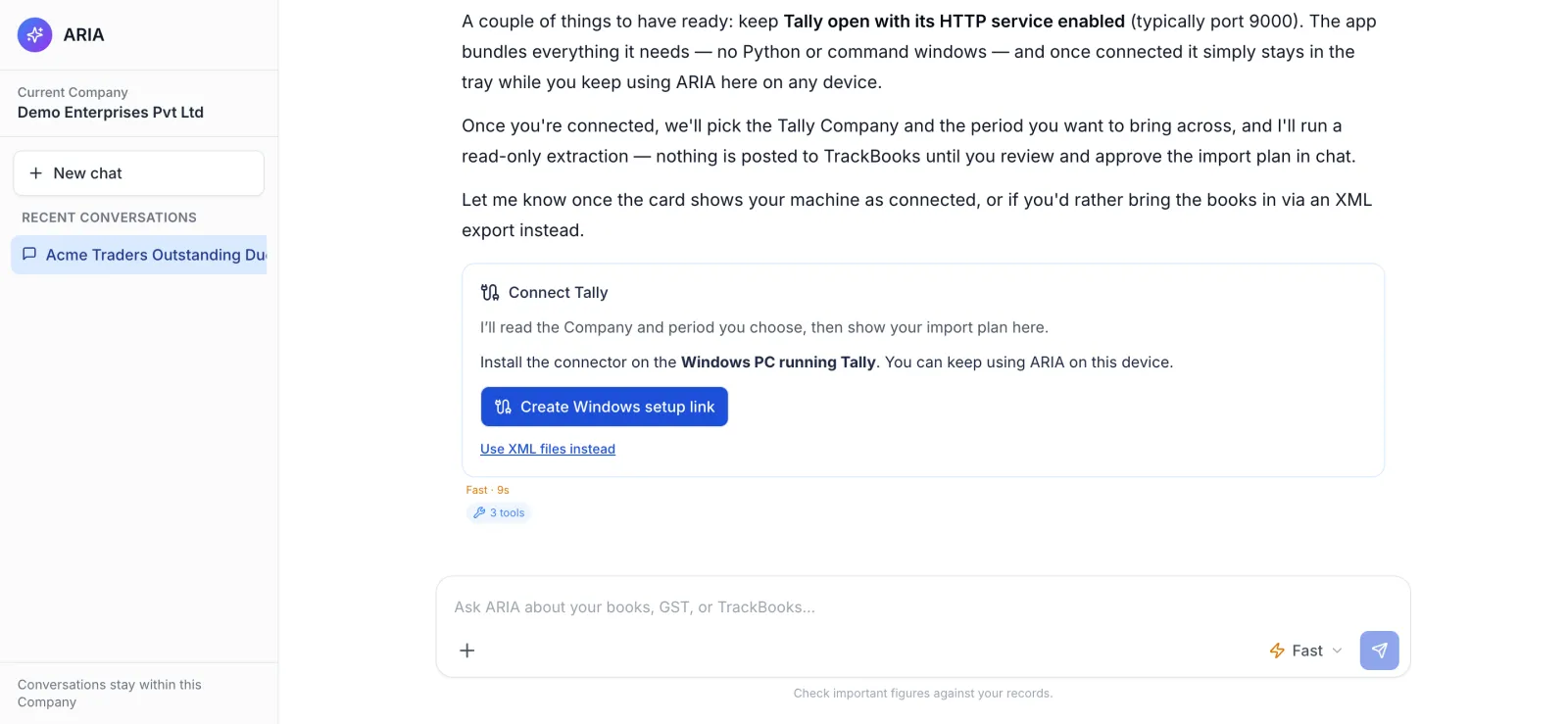
ARIA offers the Tally connector or XML import. Point of sale
An offline desktop billing application for shops that synchronises sales to the accounts.
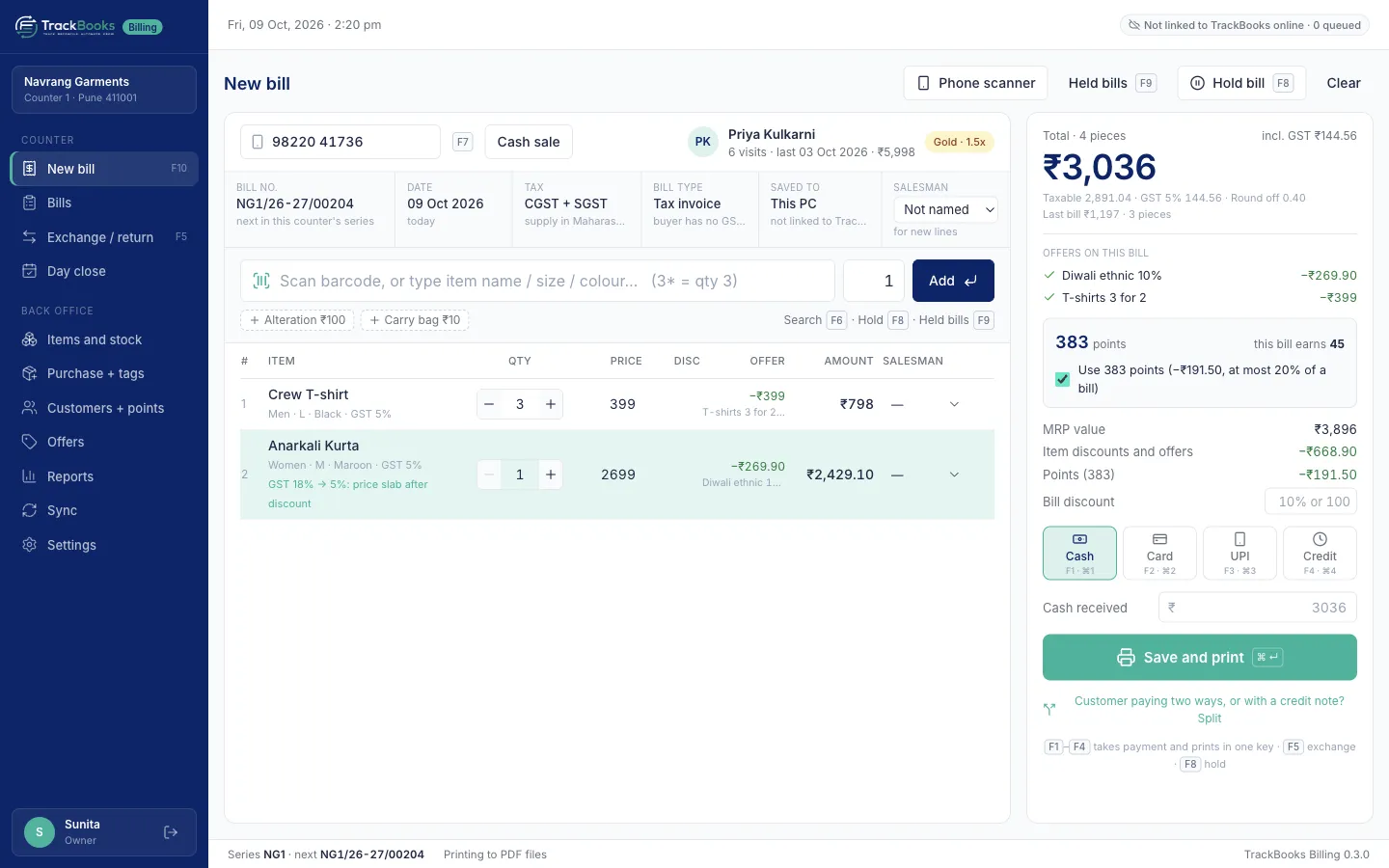
The billing counter.
Under the hood
TrackBooks is designed as a multi-tenant system with tenant isolation enforced at the database. Accounting rests on a double-entry ledger from which the statements are derived, and the GST returns are built from the source documents. AI is used responsibly: it extracts documents, suggests mappings and answers questions, with costs kept low and control kept with people.
Documents and bank statements take opposite routes. OCR was not reliable across the variety of Indian invoices, so extraction uses vision-language models chosen on accuracy, speed and cost, with caching and an AI credits system that keeps the cost visible. Bank statements use deterministic parsers for 27 banks, with AI only as the fallback.
Extracted data is validated before it becomes an entry, every entry is shown balanced before posting, and a reference company's financial statements must match to the paisa on every release. Performance and security were first-class concerns from the start, not afterthoughts: both were tested continuously as the system grew, with independent security reviews before release.
The code was written with Claude Code and Codex, with an engineering process built for them: agree the intended capability first, define completion as conditions that must hold, and review with a second independent model.
- React and TypeScript; FastAPI on Python; PostgreSQL.
- Vision-language and reasoning models through OpenRouter, Gemini and Claude; an evaluation suite and cost tracking for the assistant.
- Tauri and Rust for the point-of-sale application; WhatsApp Cloud API; GST portal access through a GST Suvidha Provider.
- Docker and Caddy on a private server, with encrypted off-site backups.